
Visit Socotra
Where the Trees Bleed Red
Cut into a dragon's blood tree and dark red resin runs out — the reason sailors, physicians, and alchemists have been drawn to this tree for thousands of years.
August 25, 2026
The name sounds invented for a tourist brochure, but it is centuries old and entirely literal. Cut into the bark of Dracaena cinnabari, and within minutes a resin the colour of dried blood begins to seep out, thick and dark red against the grey wood beneath. Sailors who anchored off Socotra in antiquity called it exactly what it looked like, and the name stuck in every language that has borrowed it since.
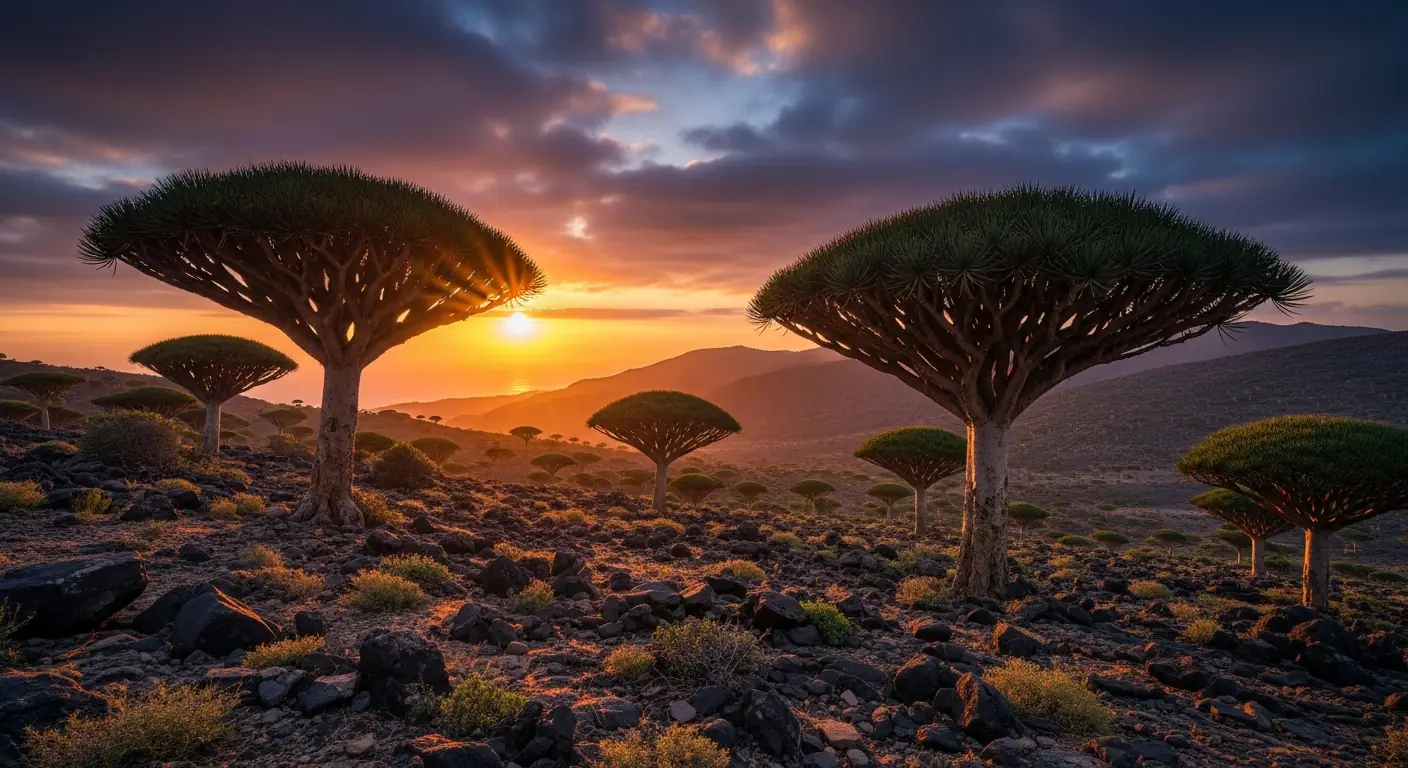
The tree's shape is what most people notice first — a canopy pushed flat and wide, like an umbrella built by someone who had never actually seen one. That silhouette is not decoration. On a plateau exposed to relentless sun and thin soil, a flat canopy shades the widest possible circle of ground beneath it, protecting the tree's own root system and the seedlings that depend on that shade to survive. Every dragon's blood tree is, in effect, gardening its own future.
The resin itself has a longer and stranger history than the tree's shape. Ancient traders carried it along maritime routes connecting the Horn of Africa, southern Arabia, and destinations as distant as the Mediterranean and China. It appears in Roman and Greek accounts as "cinnabar," confused for a time with the mineral of the same colour. Physicians used it as an astringent and wound treatment; alchemists and later violin makers used it as a varnish and pigment; in more recent centuries it found its way into folk medicine across multiple cultures, credited — accurately or not — with everything from stopping bleeding to easing dysentery.
None of that trade would have existed without Socotra's isolation working in the opposite direction from how it usually does. The tree itself is endemic, found nowhere else, but its resin travelled the ancient world for thousands of years, carried by people who had likely never seen the forest it came from and had no way to know an island shaped like nowhere else was the only source.
Today the forests are smaller than they once were. Grazing goats eat young saplings before they can establish deep enough roots to survive, and without active protection, a Firmihin-sized stand can thin out generation by generation. Conservation efforts on the island — fencing, monitored regeneration zones, controlled access to the densest groves — exist because the tree's odd, slow biology cuts both ways: the same isolation that made it unique also means nowhere else can replace what is lost here.
Standing under a mature specimen, forty or more years old, it is easy to miss how deliberate the whole structure is — the flat crown, the thick trunk built to survive drought, the roots reaching for whatever moisture the plateau still holds. It looks alien mostly because it is unfamiliar, not because it is arbitrary. Every part of it answers a question the island has been asking for millions of years: how do you survive here, alone, with almost nothing arriving from anywhere else.